Choosing Is Not Starting — and most systems only do one
Six methods get recommended over and over: the Eisenhower matrix, 3/3/3, Pomodoro, time blocking, eat the frog, the streak. They are not six options competing for the same slot. They are three different jobs, and most people end up holding two tools for one job and nothing for the other two.
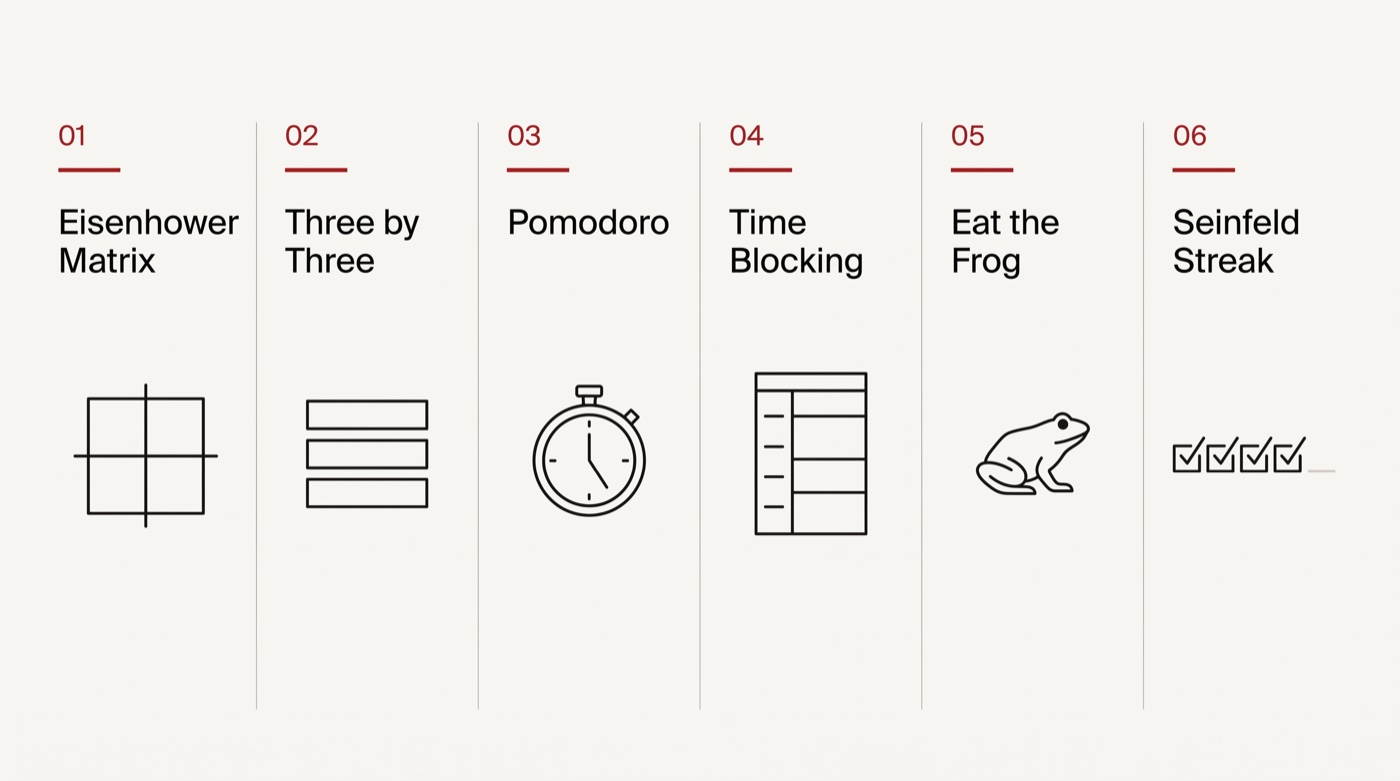
There is a particular kind of failure that looks like diligence. Someone reads about the Eisenhower matrix, sorts their entire backlog into four quadrants, feels the specific satisfaction of a tidy list, and then discovers on Tuesday morning that they still cannot make themselves open the document. So they go looking for another system. They find 3/3/3, which is also very good, and which also does not get the document open.
The problem was never the quality of the method. It was that both methods do the same job, and the job they do is not the one that was failing.
Almost every technique on the productivity shelf answers one of three questions. What deserves the time? How is the time protected once it is committed? And what happens at the moment you actually have to begin? These are separate problems with separate failure modes, and a tool built for one is close to useless against the others. A sorting method has no opinion about Tuesday morning. A timer cannot tell you whether the task was worth doing.
Sorted by that logic, the six most-recommended methods fall into place quickly, and so does the reason a lot of people cycle through all of them without much changing.
Choosing
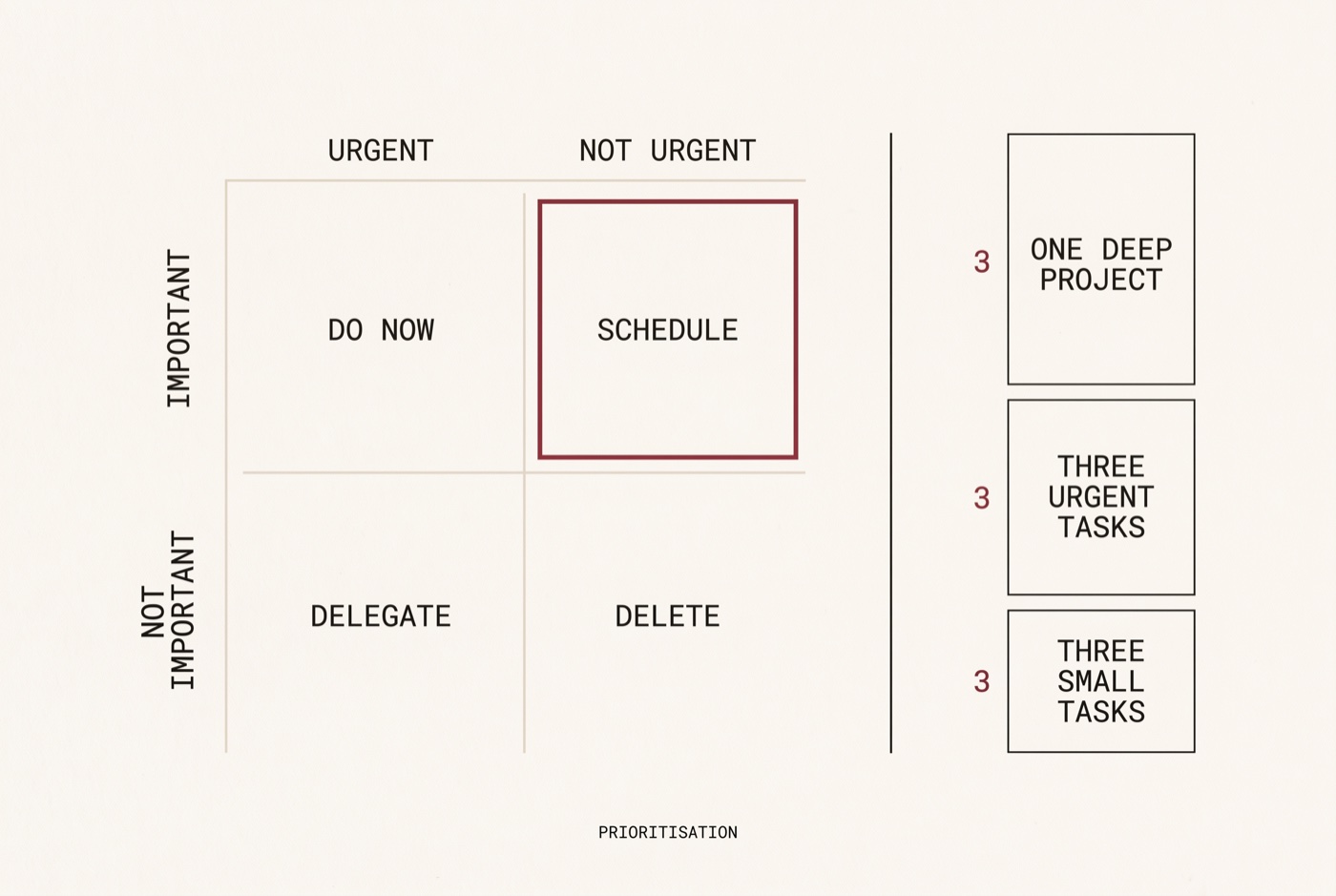
The Eisenhower matrix takes its name from a line Eisenhower quoted in a 1954 speech, crediting an unnamed college president: there are two kinds of problems, the urgent and the important, and they are rarely the same one. Stephen Covey turned the observation into the two-by-two grid in 1989, and it has been redrawn on whiteboards ever since.
Sort a task by importance and urgency and it lands in one of four boxes, but only one of them is doing real work. Important and urgent are fire drills — the outage, the filing deadline — and they never needed a system in the first place, because they arrive with their own alarm. Urgent and not important is someone else's deadline wearing a costume, which describes a good share of meeting invitations. Neither important nor urgent is where procrastination actually lives, and it rarely looks like idleness; it looks like tidying the backlog.
Which leaves important and not urgent, and that box is the entire argument for having a system at all. Strategy, training, the rewrite, the medical appointment you keep deferring. Nothing external will ever escalate any of it. No inbox will chase you. If it happens it happens because you decided it would, which is precisely why it needs a mechanism and the other three boxes do not.
The matrix costs about ten minutes once and a few seconds per task thereafter. What it will not do is get you started, and it is worth being blunt about that, because the tidiness of a well-sorted matrix is easy to mistake for progress.
Three by three, the writer Oliver Burkeman's formulation, is the more practical daily shape. Three hours on one significant project, three shorter tasks with real deadlines, three pieces of maintenance — the dentist, the expense report, the reply you have owed someone for a week. Its advantage is that it describes a day rather than a taxonomy of everything you have ever agreed to. Nine slots is few enough to hold in your head, and honest enough to concede that admin exists and will be done by you.
The matrix tells you a task is important and not urgent. Three by three puts it at nine in the morning. That is a small difference on paper and a large one in practice.
Neither survives a day with four meetings in it. On those days you get the three maintenance tasks and nothing else, and the useful discipline is admitting that at nine rather than discovering it at six.
Protecting
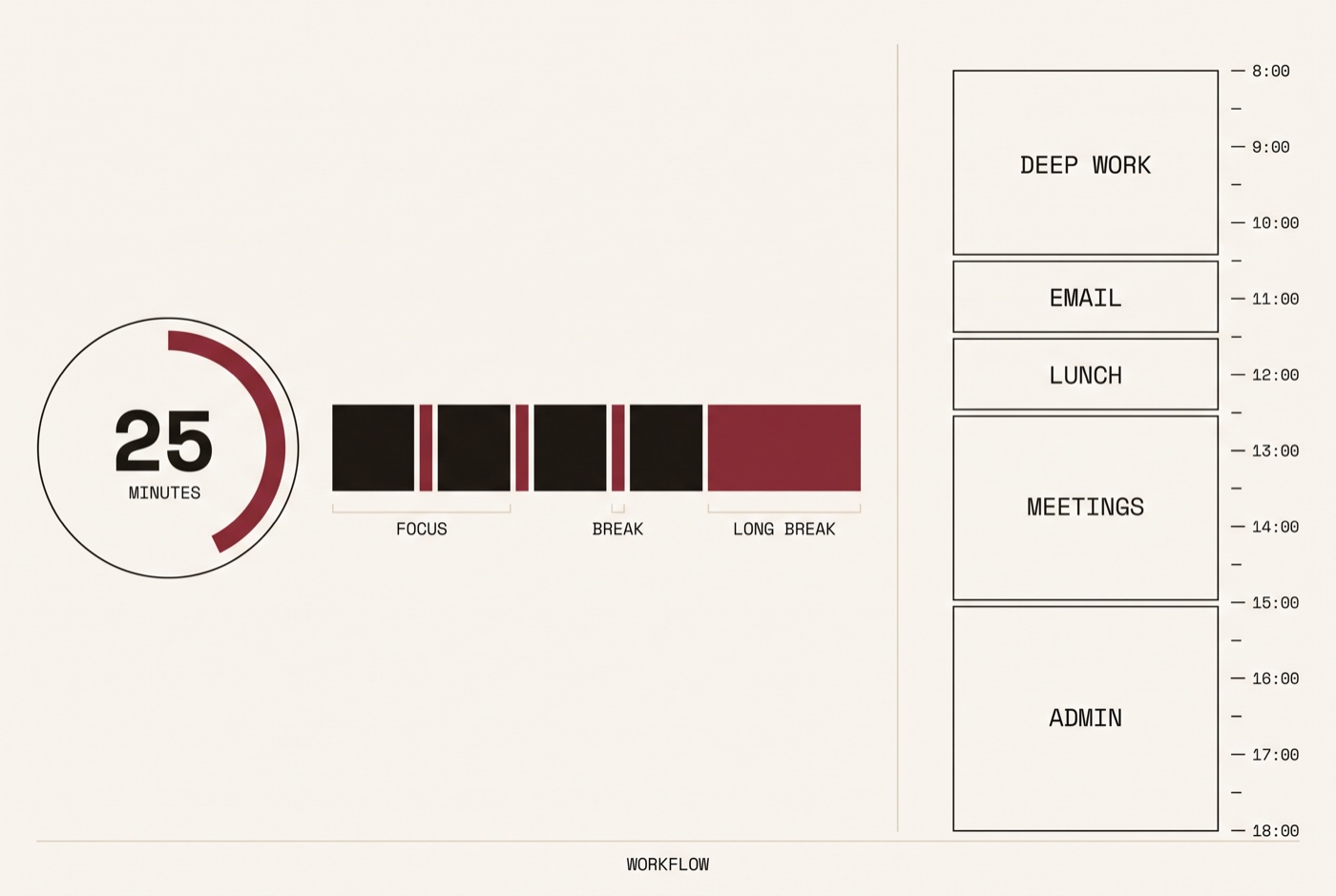
Francesco Cirillo worked out the Pomodoro technique as a university student in the late 1980s, timing himself with a tomato-shaped kitchen timer, which is where the name comes from. Twenty-five minutes of single-tasking, five minutes away from the desk, a longer break after four rounds.
The interval is the least interesting part, and the recurring argument about whether it should be twenty-five minutes or fifty rather misses what the technique is for. A timer is a permission device. Twenty-five minutes is short enough that starting costs almost nothing, which matters enormously, because starting is the expensive part of most work. It is short enough that a tedious task has a visible end. It is long enough that something actually moves.
The break has to be a real one. Five minutes of scrolling is not recovery — it is the same attention, spent worse, and you will return to the desk having rested nothing.
A timer cannot decline a meeting. It protects you from yourself, not from your calendar.
Time blocking handles what the timer cannot. Every task gets a slot, similar work gets grouped, breaks and lunch get slots of their own, and you work the calendar instead of the list.
The honest version comes with a correction that most descriptions leave out, and it is the reason the method has such a high abandonment rate in week one. A time block is a forecast, not a schedule. People block eight hours of work into an eight-hour day, leave nothing at all for the interruptions that arrive every single day without fail, watch the plan disintegrate by Wednesday, and conclude they are personally bad at planning.
Block around sixty per cent of the working day and leave the rest unassigned. The unassigned portion is not slack and it is not a buffer for feeling relaxed. It is where the day, empirically, goes.
Starting
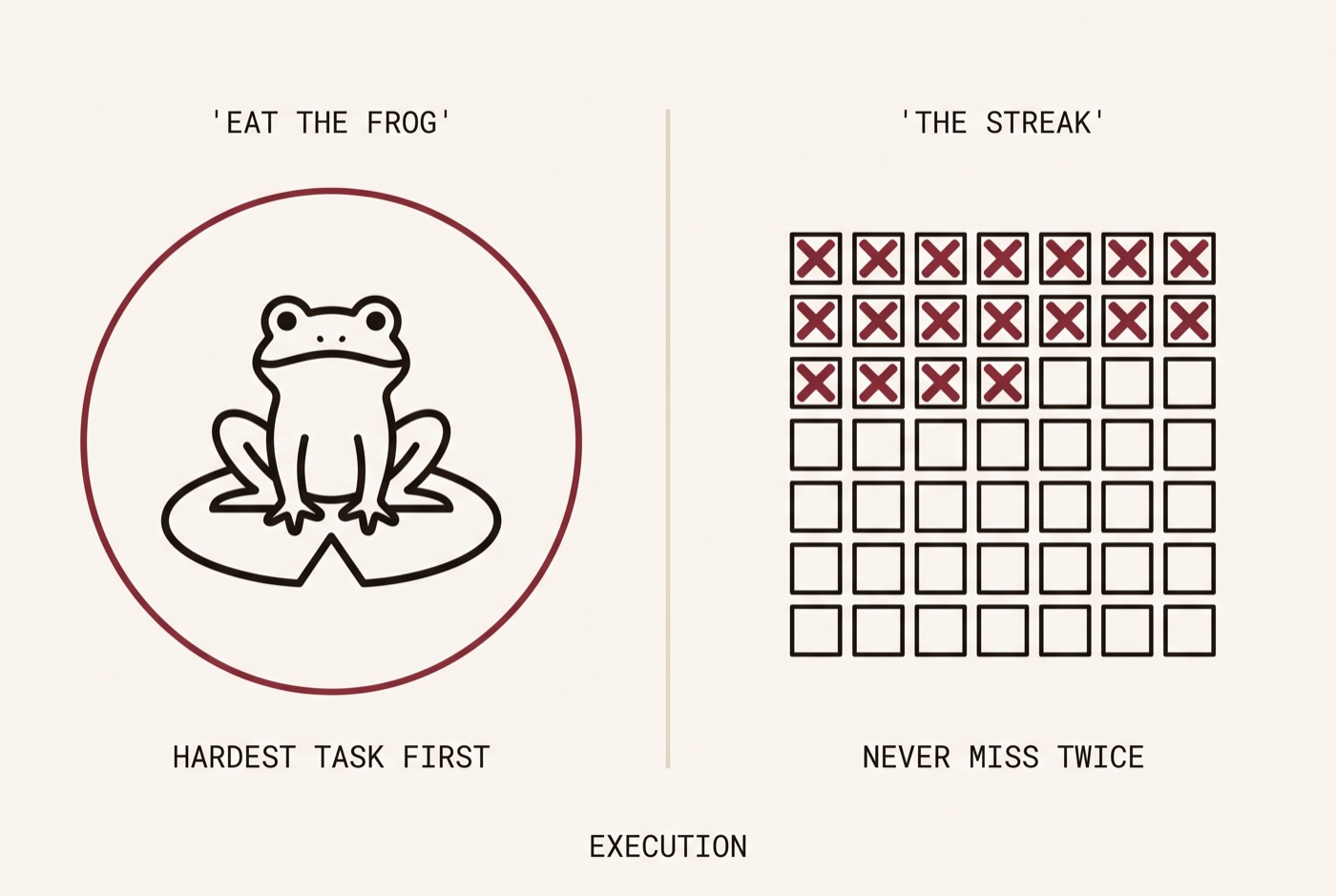
Brian Tracy's Eat That Frog! put the phrase into wide circulation in 2001: do the hardest, most consequential thing first, before email, before anything reactive.
The Mark Twain quotation that travels alongside it is almost certainly not his. Quote Investigator has looked and found no evidence Twain ever wrote or said it; the nearest earlier version belongs to the French writer Nicolas Chamfort, around 1790, and in his telling it is a toad. Tracy was passing along an attribution that was already circulating rather than inventing one, but a line repeated ten thousand times is still not a source, and a publication that recommends the method should probably not launder the citation while doing so.
The technique survives the correction, and its mechanism is narrower than the slogan suggests. It works because it removes a decision at the precise moment you are least equipped to make one. At five to nine, willpower is not the scarce resource — a decision is. Choose the frog the night before, write it somewhere you will see it before you see a screen, and the morning contains no branch. Choosing the frog at nine is not the same technique; it is planning with dread attached.
The streak is the other half. One daily action, a mark on a physical calendar each day you do it, and the chain does not get broken. Two rules carry the whole thing: the only job is today's mark, and never miss twice. One miss is an accident. Two is a new pattern establishing itself.
Its provenance is a mess worth knowing about. The method appeared on Lifehacker in 2007, written up by Brad Isaac as advice he said he received from Jerry Seinfeld backstage. Seinfeld has since disowned it in public, calling it "the dumbest non-idea that was not mine."
So the most-cited habit technique on the internet is one its namesake says he had nothing to do with, and it still works — which tells you where its power was never coming from. Not celebrity. A visible row of marks is a running record of evidence about yourself, and the reluctance to spoil it is doing all the labour. That is also the limit: it builds one habit at a time. Three simultaneous streaks is three opportunities to fail by Wednesday, after which you have learned nothing except that you failed.
One from each
Take one method from each of the three jobs and run the combination for a fortnight.
The straightforward build is three by three to shape the day, Pomodoro to get into the block, and a frog chosen the night before to remove the morning's decision. It requires no software and costs about seven minutes a day in overhead. If most of your work is scheduled around other people, swap three by three for the matrix and Pomodoro for time blocking. If the problem is consistency rather than volume, the streak matters more than anything above it.
The failure is worth naming one more time, because it is so easy to walk into while feeling productive. The matrix plus three by three is two ways of ranking a list and still no answer for Tuesday morning. Pomodoro plus time blocking is two ways of defending a block whose contents nobody has decided. Both combinations feel like a system. Both are one job done twice and two jobs left undone.
One from each. Two weeks. Then change a single thing, and only one.