P.A.R.A. Without the Evangelism
Tiago Forte's filing system contains one genuinely good idea and one well-documented failure mode. Here is the useful half — and the point at which organising your notes quietly becomes the thing you do instead of working.

Open the folder where you keep things you meant to read. Go on. Somewhere in there is an article about deep work you saved in 2023, a PDF whose filename is a string of numbers, and at least one note consisting entirely of the word "important."
Everybody has this folder. It is not evidence of a character defect. It is what happens when capturing something costs one second and processing it costs twenty minutes, repeated across several years and four devices.
The reflex, when you finally look at it, is to reorganise. This is where most people lose a weekend and gain nothing. But there is a system worth understanding here, and it has exactly one good idea in it.
The good idea is not a folder structure. It is that you should file things by what you are going to do with them, not by what they are about.
Why topic folders fail
Almost everyone's first instinct is to file by subject. A folder called Marketing. One called Health. One called, inevitably, Misc.
It feels right and it fails within months, for a reason that only becomes obvious once you have watched it happen. Subjects have no edges. Is an article about pricing psychology filed under Marketing, Business, or Psychology? You genuinely do not know, so you guess — and the next time you look for it, you guess differently. Multiply by a thousand notes and you have a library you can only search, never browse. At which point the folders are decoration.
The other failure is subtler. A topic folder gives you no signal about whether anything inside it matters now. Marketing contains a live campaign brief and a half-read blog post from four years ago, sitting at the same level, looking identical.
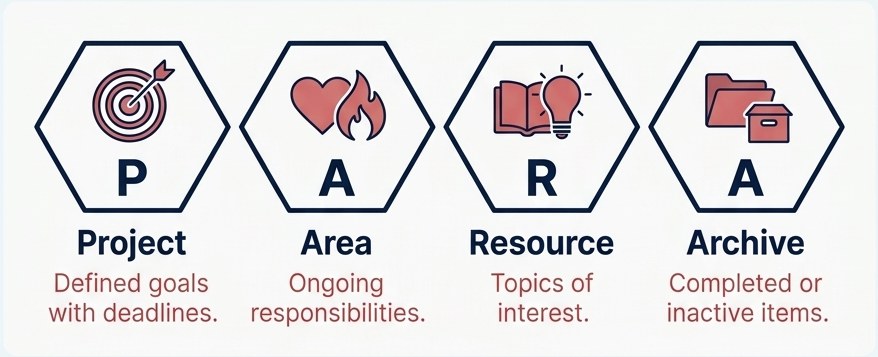
P.A.R.A. — Projects, Areas, Resources, Archives, from Tiago Forte's Building a Second Brain — solves both by sorting on a different axis: how close something is to action.
The four buckets
Projects have a finish line and a date. Ship the redesign. Plan the trip. Get the tax return in. If you cannot say what "done" looks like, it is not a project — and that test alone will empty out half of most people's project lists.
Areas are standards you maintain with no end date. Health. Finances. The car. Your team. These never get completed; they only get neglected. Keeping them separate from Projects stops a permanent responsibility from masquerading as a task you are failing to finish.
Resources are topics you are interested in with no current claim on your time. Recipes, typography, whatever you fell down a hole about last month. This is a library, not a to-do list, and it is allowed to be large.
Archives are anything from the other three that has gone cold. Finished, abandoned, no longer interesting. The point of an archive is that it makes deleting unnecessary — you can clear your working space without the small dread of throwing away something you might want in five years.
The whole structure is a single question applied repeatedly: when will I next need this? This week is a Project. Forever is an Area. Someday is a Resource. Never, probably, is an Archive.
The part the enthusiasts skip
Here is where this publication parts company with most writing on the subject.
A filing system produces nothing. It has no output. Its entire value is that it reduces friction between having an idea and using it — which is real, and is also a supporting role. The moment the system becomes the thing you tend to, you have swapped work for the appearance of work, and the appearance is considerably more pleasant. Reorganising notes gives you tidiness, visible progress, and no risk of being wrong about anything. It is the most comfortable possible way to spend a Sunday not writing the thing.
You can spot the failure in your own behaviour easily enough. If you have restructured your folders more than once in six months, or migrated apps more than once in a year, or ever felt a small lift from renaming a folder, the system has stopped being infrastructure and become a hobby. That is fine as a hobby. It is not fine as a substitute.
Forte's own framing has four stages — capture, organise, distil, express — and it is worth noticing that only the last one produces anything. Capture is cheap. Organise is pleasant. Distil is where most people stop. Express is the point, and the other three are overhead in service of it.
Running it without it running you
Three rules keep this on the useful side of the line.
Set up in an afternoon, not a weekend. Four folders. Move things in as you touch them rather than in one heroic migration. Anything you never touch again did not need filing, which is information you get for free by not doing the migration.
Let things move. A Resource becomes a Project when you finally act on it. A Project becomes an Archive when it ships. If a category feels wrong, it probably is — drag the folder and move on. A system you are afraid to alter has become a rule rather than a tool.
Give it a slot, and a small one. Ten or twenty minutes a week to empty the inbox into the four buckets. We have argued elsewhere that a weekly review only survives if it is designed for your worst week rather than your best, and the same applies here: a filing ritual that needs an hour is a filing ritual you will abandon in February.
On tools — Notion, Obsidian, whatever is already on your machine — the honest answer is that it hardly matters, and the confidence with which people argue about it is inversely proportional to how much it affects the outcome. The best app is the one you will actually open. If you are between apps, that is a reasonably strong signal that the app was never the problem.
None of this makes you more creative. It removes a specific, unglamorous obstacle: the twenty minutes of searching that stands between remembering you read something useful and being able to put your hands on it. That is a modest promise, and unlike most of what gets written about second brains, it is one the system can actually keep.